Sunday, January 22, 2012

Your moment of culinary zen:

From Elizabeth Bear's "Lucifugous":

Mrs. Smith was already seated on the divan, applying a silver fork to the pastry on her canary-yellow Meissen cake plate. She had acknowledged Sebastien earlier. Now, he touched the teacup to his lips before he set it, and its saucer, on the side table. ‘Mrs. Smith,’ he said. ‘You seem very calm.’

Her eyebrows rose over the frame of her spectacles. ‘I’m screaming inside,’ she said, and laid the fork down beside her plate. ‘But that’s no reason not to eat.’


A classic locked-room mystery set aboard a dirigible, with vampires and steampunk, that moment with the canary-yellow Meissen cake plate is still my favorite part of the story. "Lucifugous" appears in the collection New Amsterdam.

Friday, January 6, 2012

Review: "Sharpshooter" (2002)

It always interested Sunny to see how a person reacted to a glass of wine or a new food. It was a one-second preview of how they would act when faced with the unpredictable, a snapshot of how they approached experience. Some people were hardly aware they had a glass in their hand, and the wine in it would be gone before they realized they were drinking. Charlie wasn't a connoisseur and didn't pretend to be one, but he was clearly interested enough to want to stop and taste what he was drinking. Meanwhile, Monty was explaining why the rocky soil in St.-Emilion, France, was superior to the rocky soil anywhere else in the world, and why this particular wine displayed its qualities better than most.

Synopsis: Wine weenies in the Napa Valley band together to drink wine, get accused of murder, drink wine, fight about insect invasions, drink wine and then accuse each other of the murder in question. Leftover wine winds up in everyone's coffee.

Grade: C+

You guys, I really, really wanted to give this one an A.

I first ran across this series by reading the sequel to Sharpshooter, Death by the Glass, and I'm very glad I did, because it's a much better book. Call it debut jitters or working the kinks out, but there are three major things wrong with Sharpshooter:

1. I loathe the trope of the amateur sleuth who calls up a hard-working police officer and tells him to meet her for coffee in 10 minutes, and he drops everything and goes. Seriously? That's a realistic picture of law enforcement. Add that to the evidence-tampering our amateur sleuth gets up to and she should have found her ass in jail, not in a booth at Bismarck's.

2. This whole idea that said amateur sleuth can run around all la, I just dropped by to see your place and...oh...ACCUSE YOU OF MURDER. OR INFIDELITY. OR CHEATING ON YOUR TAXES. WHATEVER YOU'VE GOT GOING.

I mean, I'm sure it's a feasible thing, but I'm also sure that amateur sleuth would get her face slapped right off her head at some point.

3. There are plotholes, and then there are the Lincoln Tunnels o' Plot. There is, for example, a subplot about thievery at the restaurant that has hands-down the least believable solution ever. Also, the whole ending to the book. Just... what? What? No. NO! Very nearly OH JOHN RINGO NO.

So why didn't this book get an F? Simple. Because Gordon can write.

Her descriptions of the Napa Valley and the intricacies of winemaking and the wine business and sustainable agriculture are A-worthy. They're bleeding-off-the-page vivid and fascinating, so by the time you realize you've learned something, you just don't care because the prose is so beautiful.

Sunny McCoskey is the owner and chef at Wildside in St. Helena, north of Napa, and when her friend Wade Skord is charged with murdering the unlikeable scion of Beroni Vineyards, McCoskey throws herself into the case. Despite the obvious police interference aspect. Despite the fact that when it becomes clear she's unhinged, Wade asks her to stop. Despite the fact that you know, owning a restaurant takes actual work (Hannah Swensen, line one).

Sure things get solved eventually but I have read a ton of mysteries, people, and the underpinnings of who did what? Are as flimsy as well-baked pie crust. The why makes sense, but in no way the who, and the Boss Battle at the end is ludicrous.

However, those sentences. Those sentences. So lush and plummy and lickable, and the wealth of detail about the Napa Valley lifestyle and the restaurant life, it is pornworthy, is what, and in this case it lets Gordon basically get away with murder.

Recommended for hardcore foodies and oenophiles only.

Thursday, January 5, 2012

Let's get criminal, criminal / I wanna get criminaaaaaaal

Yeah I know. Big dork. But check out how that song's gotten stuck in your head now for the rest of the afternoon. Mm-hm. These things happen.


Super excited to be participating in Criminal Plots II, a reading challenge over at Jen's Book Thoughts. Despite the fact that I read 119 books last year* I rarely sign up for challenges because I read in all kinds of different genres and am easily distracted. But this, this is surely doable even for me.

The rules are simple: read six books this year that correspond to:

1. Novel with a weapon in the title;

2. Book published at least 10 years ago;

3. Book written by an author from the state/province/etc. where you live;

4. Book written by an author using a pen name;

5. Crime novel whose protagonist is the opposite gender of the author;

6. A stand-alone novel written by an author who writes at least one series.

I can do this!

In fact, I've already got the first three picked out:

1. Novel with a weapon in the title:


2. Book published at least 10 years ago:


(published in 1998, which is apparently more than 10 years ago although HOLY COW, REALLY??)

3. A stand-alone novel written by an author who writes at least one series:


Although I'm not sure if that last one counts; I love Elaine Viets' Francesca Vierling series, and as far as I can tell, this Josie Marcus entry, while being part of a different series, appears to be her only foodie mystery, so for me, it's a standalone. (Does that make sense? Discuss.)

I'll have to give that last one some thought. Culinary mysteries do have a tendency to appear as series, so it's not inconceivable that this is as standalone as I can manage. Either way though, I've been looking forward to this Viets book for quite some time, so I might have to devour it first. Nom nom nom.

Anyone else up for joining Jen's challenge?


*My GoodReads goal was 120. Missed it, by that much ][

Saturday, December 3, 2011

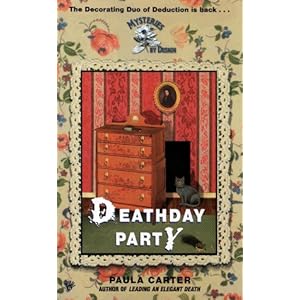
Review: "Deathday Party" (1999)


"Like I said, people who are careless with their gardening can't be trusted. You just never know what they have in their background. That's why we've got to get out of here, Jane, dear. I am not used to this kind of thing, you know."

"Well, if it makes you feel any better, neither am I. I mean, it's been years since anyone, excuse me, anything tried to impale me with pruning shears."


Synopsis: Southern decorating belle Hillary and her fish-out-of-water assistant Jane agree to cater a party for an eccentric Gothic family, but get trapped at the house by a storm. Then bodies start cropping up everywhere except the family cemetery. It's just that kind of party.

Grade: A-

While this book's technically the second of Carter's Decorating Duo of Deduction series (#1 was Leading an Elegant Death and #3 is Red Wine Goes with Murder) it's all about catering and includes a recipe, so I'm cheerfully including it here.

Broke single mother and California transplant Jane Ferguson takes a job with Hillary Scarborough, the Martha Stewart of the South, despite not knowing a glue gun from a frosting bag. Still growing accustomed to Southern eccentricities, Jane still boggles at their latest catering job: a birthday party for America Elizabeth Bean, a dead woman renowned for having killed someone who may or may not already be dead. But when a storm traps Jane and Hillary at the Bean mansion, they find their hostess dead but unable to stay in her coffin. More bodies follow suit, none of them in the family cemetery, however. And why does the local gas station attendant look just like the telephone repairman and an out-of-town preacher called in to do the honors at the party?

Cozies by now have a ton of tropes attached to them: the amateur sleuth with the failed love life, usually including a terrible ex-husband and a burgeoning relationship with the local lawman (check, check); a sassy sidekick less skilled at detecting (check); and a small town or family full of secrets (check). Bonus points if one of the sleuthing duo is a terrible driver (yup, check).

But there were two things that made this mystery really work for me. One, the banter between Jane and Hillary is phenomenal without straining credulity (a lot like the best of Mary Daheim's Judith McGonigal-Flynn and her cousin Renie) and contains a handful of laugh-out-loud moments.

The other was that one of the biggest cozy tropes, that the amateur detective is usually also a harried mother and failed domestic doyenne here is done to perfection. While Hillary's perfection in these areas highlights Jane's flaws Jane never lets it cow her and she stands up to Hillary repeatedly. You get to see how her detection skills more than make up for all the dust bunnies on her rugs.

I am deeply suspicious of amateur sleuths who have everything pulled together and still manage to have flawless hair, eyes the color of farting cornflowers and "comfortably rounded" figures. Dude, give me the whip-smart, unbrushed, covered-in-cat-hair detectives any day of the week.

I suspect part of the popularity of the Harried Amateur is commentary on the backlash against women who entered the workplace in large numbers during the late 70s and 80s. Hear me out: so many cozies that feature these women were also written by female authors, who en masse, have the effect of saying, look, I may not be the Angel of the Household, but my intelligence more than makes up for that.

Which has nothing to do with food. :)

One recipe included in the book, Hillary's Brandy Sauce, which sounds awesome. I did wish for the recipe for Hillary's pecan and cranberry quickbread, as well as more of a focus on what she recommends the Beans serve at their deathday party as a type of clue to funeral meats and traditions and whatnot, but I wasn't sorry at all that the omission of those things came at the cost of more plot and a slightly madcap dash around a modern-day House of Usher. Highly recommended.

Friday, November 25, 2011

From the table of the Iron Duke, by Meljean Brook:


One of the many things I liked about this book was the food, and how it, along with the rest of the world, had been ingeniously thought out. In a book set after privation and war, it makes sense that a fresh orange would be the most indulgent of delicacies. I like to see that type of thinking from an author. It's clever.

Take, for instance, the first lines of the book:

Mina hadn't predicted that sugar would wreck the Marchioness of Hartington's ball; she'd though the dancing would. Their hostess's good humor had weathered them through the discovery that fewer than forty of her guests knew the steps, however, and they'd survived the first quadrilles. But as the room grew warmer, the laughter louder, and the gossiping more vigorous, the refreshment table set the First Annual Victory Ball on a course for disaster.

Which meant Mina was enjoying the event far more than she'd expected to.


On the other hand, I completely agree with The Book Smugglers about the Iron Duke's cover. Gah headless man-titty.

Saturday, November 12, 2011

Review: "Death by the Glass" (2003)

"Morales is going to fucking ruin me," said Osborne, puffing as he settled his briefcase and groped for the seat belt. "He's trying to destroy my restaurant." He waited for a response but didn't get one. "Who eats Moroccan food, anyway? Who wants to eat Moroccan food?"

"Moroccans?" said Nick.


Synopsis: Luminous foodie murder set entirely in the overheated, incestuous world of high-end restaurants, with an interesting accidental sleuth and a panoply of interesting supporting characters. Minor hiccups with plotholes and strings left dangling at the end.

Grade: A-

High-stakes wine fraud and murder disguised as a heart attack compel Sunny McCoskey to again toss aside her chef's apron and don the role of sleuth. When the list of suspects includes her new lover, the celebrity chef at a posh Napa Valley eatery, the personal risks of her investigation rise dramatically.


That's the official blurb and it's both accurate and terrible. Here's what really happened.

(For all of you who've ever worked in a restaurant, lots of this will sound familiar. Although if that involves murder, yikes. Talk about your dead-end jobs...)

Sunny McCoskey operates a small gourmet restaurant with her friend Rivka when they're not gossiping with their effeminate heterosexual winesnob friend, Monty, who in my head was both looking and sounding like fashion designer Michael Kors. Go with it. I watch a lot of Project Runway.

Sunny and Rivka hop across the street to do a charity dinner at Vinifera, mainly because of the hunky chef there, Andre. There's some talk about getting back on a relationship horse because Sunny's kind of a wiener. But she's also well-actualized and complicated and an insomniac, so of course Andre leaps at her like a dog on a bone.

However, and this was a little weird, right after her date with Andre (not her dinner with him, thanks) Sunny gets consumed by finding the killer of Vinifera's owner. Who no one thinks got murdered. It's safe to say that Rivka's right on with her assessment of Sunny's honking big intimacy issues.

It's a great book. Sunny and Rivka are fantastic and funny friends and there's food everywhere in this book, mostly being prepared rather than eaten, but also wrapped delicately into such descriptions as "Near the front, parked under a tree, was a Mercedes sedan the color of vanilla ice cream. A black 911, too new to have license plates, sat nearby showing a tease of cherry-red disk brakes through the silver wheel covers."

There are gorgeous descriptions of the Napa Valley throughout, although you do have to roll with the fact that Napa's the kind of place where you can belly up to the bar and talk to the bartender about what kind of red wine to take on a booty call...while eating deep-fried olives stuffed with anchovies. Which I think we all agree are totally a bar-food.

Napa's a very upscale boondocks, or as Rivka and Sunny put it, "Les Boondocks".

There are a couple plotholes, like a scene with a villain menacing early on that's oh, you know, never mentioned again, and we never do find out if Sunny gets her act together with Andre, even by the end of the book. And there are references to things in a previous book but hello, it's a series, so I should just calm down and get over it.

Or just read the rest of the other books.

Saturday, October 29, 2011

In the kitchen with five (hardboiled) detectives

Southern California surf PI Boone Daniels:

“Everything,” Boone says, “tastes better on a tortilla.” This is an article of faith with Boone. He’s lived his life with it and believes it to be true. You take anything—fish, chicken, beef, cheese, eggs, even peanut butter and jelly—and fold them in the motherly embrace of a warm flour tortilla and all those foods respond to the love by upping their game. Everything does taste better on a tortilla.

--Don Winslow, The Dawn Patrol


Inspector John Rebus:

Nothing in the world tasted as good for breakfast as stolen rolls with some butter and jam and a mug of milky coffee. Nothing tasted better than a venial sin.

--Ian Rankin, Knots and Crosses


Detective Inspector Jack Frost:

Two dubious-looking rashers of bacon sweated and cowered in the corner of the fridge. He took them out, sniffed them, and decided to chance it.

The rashers were laid into the frying pan with a generous chunk of recycled dripping, then two eggs were cracked and dropped in, and everything started sizzling and spitting and filling the kitchen with greasy smoke. He turned his attention to making the tea. No tea bags left. Damn and flaming blast!

He ferreted around in the rubbish bin and found a swollen, soggy used bag looking like a drowned mouse. Beggars can't be choosers, he thought as he dumped it in his cup and drowned it again in hot water. Then he buttered some bread, tipped the contents of the frying pan onto a plate, fished a knife and fork out of the washing-up bowl, and settled down to eat.

--RD Wingfield, A Touch of Frost


LAPD Homicide Detective Harry Bosch:

Bosch gave her Pounds's serial number and then the names Gordon Mittel, Arno Conklin, Claude Eno and Jake McKittrick. He said he needed the home addresses on their licenses.

He was put on hold again. During the time he waited he held the phone to his ear with his shoulder and fried an egg over easy in a pan on the stove. He made a sandwich out of it with two slices of white toast and cold salsa from a jar he kept in the refrigerator. He ate the dripping sandwich while leaning over the sink. He had just wiped his mouth and poured himself a second cup of coffee when the clerk finally pciked back up.

--Michael Connelly, The Last Coyote


Psychologist and very serious detective Alex Delaware:

We went into the house. [Milo] fixed himself a bowl of Cheerios and milk, stood at the counter and spooned the cereal down nonstop before pausing to catch his breath. "Hand me a napkin."

--Jonathan Kellerman, Silent Partner


Conclusion: I would never eat at Inspector Frost's house. I might not even touch anything or sit down.